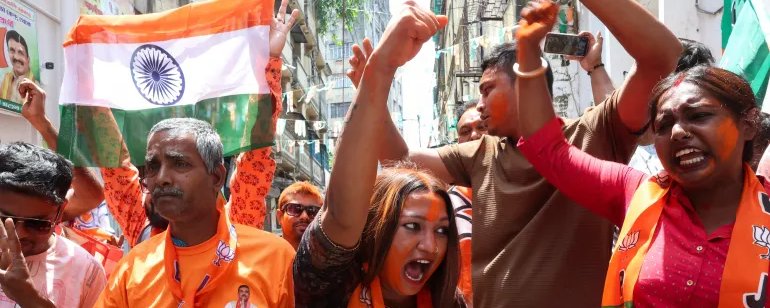
 Bengalis celerbrating BJP win
The Culture of Humiliation
Reproduced from: https://x.com/greatbong/status/2053663228987883743 from Arnab Ray
Bengal, they say, is a land of tradition. And post-electoral violence is one of its worst, started by the Left Front and continued by the TMC. This time, though, at the time of writing, things have been different, in terms of the scale of violence, with the BJP rulers going out of their way to reduce the temperature, and whether they succeed or not, or whether they even mean it, we will find out in a month, but that's not really what this piece is about.
There is something else I have noticed this time that is unique. Groups of people celebrating spontaneously, in the cities and even more in the villages. These are not party cadres that have been brought from outside by party buses to project something for the cameras (there is that too) but ordinary people venting, making a pilgrimage to the outside of Abhishek Banerjee's house to sloganeer against him, food delivery workers talking to the camera about the daily humiliations the security of TMC satraps would inflict on them as supremos would block the outside roads of their houses like medieval lords creating a moat.
Stories. So many stories.
There was this influencer who recounted an anecdote, which could be true or not, but I found it believable, as it aligned with my own experience of what "parar dada"s, or local muscle, would do, except I experienced it under the Left Front rule. A local tough from the then-ruling party asked him for five lakhs for a cultural program the local party wanted to organize, and when he said he didn't have it, the goon told him that every time he refused, the number would go up by five thousand. He kept refusing. The number kept climbing. Then one day, the authorities piled the garbage of the entire neighborhood against the front door of his business establishment, and he had to clean it by hand, and when he did, they came and dumped more.
Yes, that's why they are out in the streets now. Whether the new dispensation will be better or not, we will find out. But at least the old guard is gone, and people are no longer afraid of saying "good riddance" in a very public way.
Politics is a business globally; no matter what politicians say, the management career track of a democracy. It comes with an entry cost and an expectation of returns proportional to that investment.
Politics is a business globally; no matter what politicians say, the management career track of a democracy.
Capital in the business of politics comes in three forms. You can either bring money, liquid and raw, from family wealth or from business. Or you can bring human capital, which is why Bengali film stars end up in Parliament, and political parties aggressively woo religious and community leaders who command large congregations in rural Bengal. Or you can bring in muscle, which is why Sheikh Sahajahan operated with impunity. Most serious politicians bring in some combination of all three. This capital is invested in your own election, and a part of the capital, converted to cash, goes upward to the party for general overhead, in the way a university skims from a researcher's grant, but let's just call it the "branding overhead." This overhead is spent partially for the party's overall administration, and partially goes to the pockets of those who drive the party, with the distributions proportionate to what they bring to the party.
Success, that is getting elected, is the time for you to get your returns on that investment. That return comes in two forms, money and power, and they are the same currency in different denominations, freely convertible into each other. Money is obvious. It's that thing you find in hard suitcases or in electoral bonds. Power is slightly different: the chairmanship of the local municipal corporation, the ability to get things done, the phone call that gets answered, the officer who stands up when you walk in. The ROI on political capital, when the system works, is considerable. That is why people do it, and that is why they reinvest the capital they make into the next electoral run, ensuring an optimum asset mixture of raw cash, influence, and muscle.
The problem in a democracy is that there is never enough return for everyone who has invested. This is where ideology comes in. Ideology is a subsidy that lets a party run far more people than the money-power pool can ever actually pay out. The BJP or the CPIM worker who goes home with nothing material still goes home with something, because his side won, his beliefs were validated, and that feeling is worth something real. It is the same feeling that makes you argue politics on WhatsApp at the cost of a friendship, no rupees changing hands, just the satisfaction of feeling right. The ideological party can field a much larger army because most of that army runs on belief, and not payment. Not everyone is in it for the money or power.
TMC had a unique disadvantage in that it is truly a naturally occurring ideological vacuum. Maa Mati Manush are three words placed next to each other, and there is no belief system underneath them, no enemy whose defeat would feel like victory, no cause a cadre could point to when he went home empty-handed. That's why post-election violence was a thing; it is what the majority got as a non-monetary reward for their field work, but not everyone is here for violence, and as a matter of fact, most people find it abhorrent. The TMC tried Bengali nationalism as a way of providing the substrate of ideology, but it is a difficult sell when so many of your MPs cannot speak a word of Bengali (recently, a TMC MP spelled fish in his tweet as "machi", or a housefly), and this is where BJP running a local Bengali fish-friendly campaign took the wind out of TMC's sails.
Which meant the reason you did TMC was for what you would get out of it. Nothing more. Nothing less.
And then there was another structural disadvantage. In most states, political corruption runs on growth, a highway gets built, and the contractor kicks back a percentage; a factory opens, and part of the cost of doing business flows to the party. The corruption is parasitic, but the host survives and sometimes even thrives. TMC never had much of that to work with. Bengal did not develop, and so they turned inward and started extracting from the bottom, from the cameraman working two shifts a week in the Bengali film industry, from the paratha seller at the railway station, from the boy selling lebu-logenze on the train who handed ten rupees of his fifteen to the ticket checker, the last one being a line from an Anjan Dutta song from the 90s, just to show that cannabilzing its weakest is a legacy from the Left.
Power, too, is a function of growth, but when the market does not grow, positions of power also stop growing. And so, with no money to make and no power to obtain, to recover your investment in your politics, you turn towards a malignant expression of it: the humiliation of those who do not have power or money or both. It manifests in making someone wait outside a door that will never open, piling garbage against a man's house, not returning calls, postponing meetings on a whim, traveling in twenty-vehicle motorcades to inconvenience ordinary people, making the Swiggy delivery man take the long route even though the road is empty, and when he asks why, saying "security" and slapping him on the cheek. It manifests in calling everyone anything you like and then, when people do the same back, having the police knock on their doors. There are so many things I could write about here, including my own experiences, but you get my point.
Power is a function of growth and when market does not grow, it manifests in making the Swiggy delivery man take the long route even though the road is empty, and when he asks why, saying "security" and slapping him on the cheek.
Unlike money and power, the ability to humiliate has no ceiling and is restricted only by your imagination and the number of people you have under your thumb. Think about business class on a plane, where the passenger in 2A gains nothing material when economy passengers are barred from his bathroom, the plane does not fly faster, and his seat does not get wider, but people pay real money for that barrier. The ability to make someone wait, to make someone feel smaller, to make someone understand their place: that is worth something. It has always been worth something.
Winning politicians, people who had actually won seats and had no material grievance to speak of, still came forward to say how impossible it was to get a meeting with Abhishek Banerjee, how completely they were shut out, how small they felt as veteran politicians being coached by twenty-something political consultants from an agency hired by Abhishek Banerjee, IPAC. There are movie celebrity TMC MPs who are today acknowledging that the culture of the party refusing work to those who even mildly objected to TMC may have contributed to their fall, the humiliation heaped on talented artists who had to beg to get work, or fall at the feet of TMC powerbrokers in the industry.
Every political culture has some of this: the small man who gets a little power and immediately needs someone below him to feel it. India has more of it than most, and it is not unique to Bengal or to TMC. Himanta Biswa Sarma, the powerhouse politician from Assam, felt it acutely in a meeting with Rahul Gandhi, where the head of the Congress party focused more on his dog than on urgent political matters. He walked out and eventually took the entire northeast with him. As an aside, the Congress, another party whose ideology has hollowed out into dynasty maintenance, is further along the path to obsolescence than the TMC.
People can put up with politicians making money. They expect it. They can absorb the drunk exercise of power. What they cannot tolerate indefinitely is being made to feel like they do not matter, like their time is worthless, like their dignity is forfeit simply because some local functionary needs to feel big.
That is a different kind of debt.
And the people outside Abhishek Banerjee's house, the delivery workers on camera, the women recounting what they went through: they were not celebrating a political victory or feeling hopeful of the future.
All they were saying, for those who cared to listen, was that they had not forgotten.